How to Transition Aging Campus Heating Plants Toward Net Zero Operations
Blog
6 min read
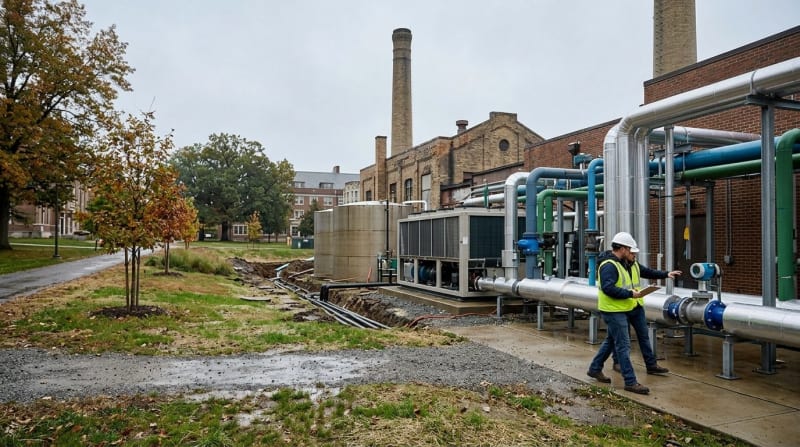
A century-old steam boiler in your central utility plant failed an emissions inspection while your trustees expect a verified net-zero trajectory. Transitioning an aging campus heating plant toward net-zero operations requires converting legacy high-pressure steam distribution to low-temperature hot water, harvesting wasted thermal energy with heat recovery chillers, and buffering winter peaks using geo-exchange boreholes and stratified water storage. Executing this transition through phased infrastructure upgrades allows institutions to systematically eliminate fossil fuel reliance without interrupting active academic calendars.
In modern higher education campus planning, utility directors and facilities leaders face mounting deferred maintenance liabilities alongside institutional climate commitments. Commercial and residential buildings account for 40% of total energy in the United States, primarily driven by heating and cooling loads. Modernizing central plants from fossil fuel combustion to electrification is the most impactful intervention a college or university can make to slash institutional carbon output.
Conducting a Comprehensive Thermal Load and Plant Assessment
A successful thermal plant transition begins by quantifying the remaining useful life, combustion efficiency, and maintenance debt of existing plant assets. Most legacy boilers operate well below their nameplate efficiency due to degraded burner management controls, scale buildup on firetubes, and uninsulated boiler shells. Engineers must audit these central assets while mapping the campus distribution network to identify hidden thermodynamic waste.
Distribution assessments frequently reveal that steam trap failures and condensate drainage issues waste a substantial portion of generated heat before it reaches a single building. High-resolution sub-metering is essential to measure true energy consumption at each facility boundary. Facilities teams should meter heating and domestic hot water demand separately across residence halls, instructional spaces, and energy-dense research laboratories to develop coincident peak profiles rather than relying on estimated averages. To support complex assessments, the U.S. Department of Energy selected nine organizations to implement regional onsite energy technical assistance partnerships to help operators screen onsite technologies like heat pumps, district energy, and thermal storage.
Lowering Building-Level Heating Demand Before Central Conversion
Downsizing central plant equipment requires reducing peak thermal loads at the building level first. Uninsulated historic building envelopes and single-pane fenestration create massive heating spikes on design days. Sealing building envelopes, adding secondary interior glazing, and updating roof insulation reduce design heating loads, allowing engineers to specify significantly smaller central equipment.
Terminal units inside connected buildings must also be converted to accept lower supply water temperatures. Legacy heating systems typically circulate water at 180°F or steam at 212°F, but modern heat pump systems run far more efficiently at temperatures between 105°F and 130°F. Replacing undersized perimeter radiators and air handler reheat coils with larger hydronic coils enables buildings to maintain thermal comfort with low-temperature water. Building operators can implement supply water temperature reset schedules within the building automation system, as shown in this Python logic:
def calculate_supply_water_temp(oat_f, min_oat=10, max_oat=60, min_sat=110, max_sat=140):
    """Calculate hot water supply setpoint based on outside air temperature (OAT)."""
    if oat_f <= min_oat:
        return max_sat
    if oat_f >= max_oat:
        return min_sat
    return max_sat - ((oat_f - min_oat) / (max_oat - min_oat)) * (max_sat - min_sat)
Advanced control routines can be modeled prior to deployment; researchers at CU Boulder developed the Advanced Controls Test Bed to interface high-fidelity building simulations with Python controllers for sequence validation.
Transitioning High-Pressure Steam to Low-Temperature Hot Water
Executing a steam-to-hot-water conversion across a university campus requires a phased distribution overhaul that avoids broad outages. Direct-buried, pre-insulated shallow hydronic piping networks can be installed parallel to existing steam trenches over multiple summer construction seasons. This dual-pipe strategy lets the central plant serve legacy steam loops while incrementally commissioning completed hydronic branches.
During multi-year conversions, decentralized building-level heat exchangers isolate individual facilities, translating steam loop heat into building hot water loops until the central plant shifts fully to hydronic distribution. Facilities teams must also electrify specialized high-pressure steam loads, such as autoclave sterilizers in science buildings and commercial steam kettles in dining centers. Removing these specialized process loads liberates the campus heating plant decarbonization program from having to maintain inefficient high-pressure steam delivery year-round.
| Parameter | High-Pressure Steam Loop | Medium-Temperature Hot Water (MTHW) | Low-Temperature Hot Water (LTHW) |
|---|---|---|---|
| Supply Water Temp | 250°F to 350°F (Steam) | 160°F to 200°F | 110°F to 135°F |
| Thermal Distribution Losses | High | Moderate | Minimal |
| Heat Pump Compatibility | None | Limited (Cascade systems) | Optimal (Direct water-to-water) |
| Piping Material | Carbon steel with expansion loops | Welded steel with insulation | Pre-insulated flexible polymer or steel |
| Operational Safety | Pressurized safety hazards | Moderate pressure risk | Minimal thermal and pressure risks |
Deploying Industrial Heat Pumps and Geo-Exchange Systems
Industrial water-to-water heat recovery chillers serve as the primary heating source in a modern district energy decarbonization roadmap. These units harvest reject heat from continuous year-round cooling demands, such as data centers, supercomputing clusters, and life sciences laboratories, and elevate that energy into the campus heating loop. Interdisciplinary design and engineering teams at HGA (HGA Architects and Engineers) coordinate the thermal modeling, energy master planning, and engineering services required to integrate these central utility networks with architectural master plans.
When campus cooling and heating loads do not balance simultaneously, a geo-exchange central plant retrofit provides the seasonal thermal battery. Vertical closed-loop borehole fields drilled 400 to 800 feet into the ground beneath open quads or athletic fields extract heat during the winter and reject surplus summer heat back into the earth. For extreme winter conditions that exceed heat pump output, facilities can maintain a small array of electric boilers or backup biofuel burners, maintaining system resilience without fossil-fuel baseload generation.
Adding Thermal Energy Storage for Peak Load Shifting
Stratified hot water storage tanks decouple thermal energy generation from instantaneous building consumption. Sizing hot water storage tanks to hold several hours of peak campus demand prevents primary heat pumps from cycling inefficiently during morning warmup spikes. The water in the stratified tank naturally separates by density, keeping hot water at the top ready for delivery while cooler return water settles at the bottom.
Thermal storage shifts electrical usage away from regional grid peak hours. Campus operators can charge the thermal tanks overnight when electric rates and grid carbon intensities are at their lowest point, discharging the stored heat during morning peak hours to reduce demand charges. This operational buffer allows the central plant to run its heat recovery chillers at a steady, optimized coefficient of performance regardless of sudden campus load swings.
Verifying Plant Performance and Carbon Abatement Metrics
Decarbonizing a central utility plant delivers immediate, measurable drops in campus Scope 1 greenhouse gas emissions. Campuses must verify that supply temperatures stay within engineered limits during sub-zero cold snaps, ensuring that heat pumps deliver thermal comfort under design-load conditions.
Engineers monitor ongoing system performance by tracking system-wide coefficient of performance, comparing electric energy input to delivered thermal energy output. Decommissioning steam infrastructure also saves millions of gallons of treated water annually by eliminating blowdown, vent losses, and evaporative cooling tower drift. These operational milestones provide the transparent, verifiable data points required for annual institutional sustainability filings and regional regulatory reporting.